Friday, June 29, 2012

Ploughlands and work weeks: Ch 2 'Furroughs and Roods'

To recap. We have a fictional Angle-Land inhabited by a race of Engle-Exxon warrior farmers led by the 'hus-bund' who with his 'wif' oversees a 'family/household' drawing their subsistence and other income from the products of their 'hide' consisting of 120 acres of arable spread among an open three-field system plus rights over common woods, pastures and meadows.

An Anglish acre is amazingly enough exactly equal to a modern American statutory acre (English acres varying by region), which American acre measures 43560 sf. But your Anglish farmer did not measure by the square foot, instead each of his acres, topography allowing, was one furlong by four roods or perches wide. A 'furlong' was considered to be the length of a 'furrow', or grain planting strip, that could be plowed by a standard eight-ox plough team in a single pull, being 220 yards or 660 feet long. A 'rood' or 'rod' or 'perch' was the length of the ox-goad typically carried by the ox-boy who with the ploughman made up the human component of a plough-team, with that goad or 'rood' being 16 1/2' long. Now if our Anglish ploughman had a four function calculator he could have multiplied a 660' ft furrough-long x 4 x 16.5' rood and come up with a calculated 43560 sf (660 x 66). That is our American land measure system only seeming to be arbitrary.

And here is where things get interesting. The following is a description of an 'acre' from an English web page Hemyock Castle: Glossary of Ancient Weights and Measures
Acre (area):
(Anglo-Saxon field.) The land area that can be ploughed by one ox team in a day - actually in a morning because the Oxen would need resting in the afternoon: They would trudge 11 miles while ploughing an acre. Traditionally in the strip field farming system, an area 40 rods long by 4 rods wide (ie. 220 yards by 22 yards). Sometimes used as a measure of width: One acre = 4 Rods wide. One tenth of a square furlong. Similar to the French Journal, and German Morgan or Tagwerk. The modern acre is 4840 square yards.
At this point the average work day and work week of the Anglish ploughman starts coming into view. One the actual portion of the day spent plowing was just half the day with the oxen being turned out onto pasture or the fallow field to browse, rest, and btw to naturally produce the very valuable manure needed to maintain fertility for the planting the next season or year. And the task of leading the oxen to pasture, to watch over them as necessary, and to lead them home could be left to the ox-boy, or as we will see boys, the ploughman himself freed up to perform other tasks. That is already we are pretty far from the Piers Plowman view of the poor villein plowing from dawn to dusk, not because he couldn't be driven to do so if need be, but because any given ox-team can only be driven so far, and oxen at least are valuable production items not to be wantonly wasted (even or especially in times when human labor and life are cheap). The implications of all this for the work week and year will be developed in the next chapter.

Ploughlands and work weeks Ch. 1: 'Once upon a time'

Physicists have thought experiments, economists have models. In each case they present an initially simplified model to make a tentative argument which may then be elaborated as variables are added back in. Me I am a medievalist. And a mythologist. And we pose our thought experiments and models in a slightly different form: the fairy tale. So here goes:

Once upon a time there was a land called Merrie Olde Angle-Land. It looked a great deal like medieval England, just simplified and viewed through a golden glow.  But just because Angle-Land is fictional doesn't mean that a story about it doesn't illustrate some truths about the parallel historical kingdom of England. On the other hand readers shouldn't interrupt the story with notes that "Well gee, field systems and social organizations were different in medieval Kent, what do you say about that!?" Just this: well that is England, this story is about Angle-Land and an Anglish historical and economic and social environment that is derived from but not identical to its English counterpart. So let's recommence:

Once upon a time there was a land called Merrie Olde Angle-Land. At the time of our story it was some seven centuries remove from an invasion of the Engle-Exxons who had slaughtered or driven out the previous Keltic-Romish inhabitants (after asking them for names of certain rivers and cities). The Engle-Exxons were a race of free Germanic peasant-warriors who while having a native aristocracy and ruled by kings organized their daily and yearly routines via a rude democracy consisting of male householders who held local courts and a yearly Witangemoet to settle such things as taxation. (on the other side of the Anglish Channel, the Frankels called it a 'parlement').

After the conquest of the portion of Keltic-Romish Brittia they would call Angle-Land, the Anglish divided the fertile regions into 'hides', each consisting of enough arable (i.e. plougable) land and associated woods, pastures and meadows to support a free peasant 'family'. As a side note the Anglish 'family' was not typically either the modern nuclear family or a Mediterranean style multi-generational family led by the oldest surviving male but instead a 'household' headed by a 'hus-bund' and 'wif' (our modern 'husband and wife') and including minor children and often one or more dependent/retired parents of the hus-bund or wif plus a handful or less of house and farm servants often enough the young adult children of neighbors who had yet to marry and establish their own 'family' in their own household. But on this perhaps more in later chapters.

The 'hides' as originally established in Angle-Land consisted uniformly (unlike England where the variety was bewildering) of 120 acres of arable distributed thoughout a large 'open' field itself divided into three parts to facilitate what was known as 'three course' farming. In this style of farming each field would be in a different stage of the growing cycle, one ploughed/seeded/sprouting, a second in full growth/being readied for harvest, and a third lying 'fallow' or unploughed at any time in that year. And here we have our first implication for labor exploitation: in any given year only 80 out of every 120 acres even gets ploughed, and only 40 acres in any given ploughing season (meaning there are two). As we will see in the next chapter or so this has large implications for the typical work week.

Thursday, June 28, 2012

Mandate NO! MLR SI! (from Angry Bear)


(Crossposted from Angry Bear)

No not the striking down of the mandate part, heck probably a thousand fingers were poised over an equal number of 'Send' keys when the ruling came down. Me? I took a shower and started thinking about the practical implications of ACA as it will operate under current law as modified today.

Starting with the MLR. Which you did hear about here first in this AB post from July 2009 HR3200 Sec 116: Golden Bullet or Smoking Gun . MLR stands for Medical Loss Ratio which in the final version of ACA was set at 85% for the Group market and 80% for the Individual market for health insurance policies issued by private insurers. Now 'Medical Loss' is itself an interesting term of art, it represents the actual amount of insurance premiums collected 'lost' via being expended on actual care paid for under your policy. That is for insurance companies the actual end service being delivered from purchase of their product is from their perspective a dead loss to be reduced. Hence a business model built around denying claims.

MLR minimums start to flip that model on its head. Under the rule if the ratio of premium collected to provider payments issued exceeds 15% or 20% respectively in Group or Individual market the difference has to be rebated to the policy holder. And indeed such rebate checks actually went out this year, this provision having already kicked in. Well after this morning's ruling that rule will continue to operate until specifically repealed. And it is important, though maybe not as much as I was able to convince Donny Shaw of when he put this post up on Open Congress on Nov 14, 2009 The Most Important Health Care Reform Provision You've Never Heard Of. For example Richard Escow of HuffPo and elsewhere is of the opinion (expressed semi-privately to me and some others), that while important MLR can be gamed. And in fact I discuss that somewhat in my original 2009 post, feel free to rip on this in comments. Me? I still think MLR is transformational.


So what things are NOT included as 'medical losses'? In short: administration, management, and direct profits from operations. (For example gains from retained and reinvested profits would not I think count against the company). Currently a lot of health insurance administration is focused on making sure that people likely to submit claims don't get signed up and/or denying claims to those who for whatever reason obtain coverage. Well various separate 'must cover' 'no pre-existing condition exclusion' rules take care of much of the first part, under ACA the companies have little room to just turn customers away. And MLR installs limits on the second part. While companies have an incentive to trim their medical 'losses' as close to the minimum as possible, every dollar spent doing so puts a squeeze on the same 15% or 20% of premiums they need to pay management salaries and return profits to shareholders. While every dollar squeezed out of the claims process by increasing efficiency and throughput of claims (i.e. actually paying providers on a timely basis with a minimum of paperwork requirements) leaves that much left over for management and shareholders. Gosh all of a sudden we have a business model based on efficient DELIVERY of services rather than DENIAL of them.


Paging Rusty Rustbelt! And Mike Halasy! Because I would love to see how this argument plays to people from the provider community. Particularly folk who have been on both sides of the overall issue. And of course I welcome comment from everyone else. I have been largely absent from the Health Care Debate since actually passage of ACA, the ball went into the lawyers' court and I am if anything less a lawyer than I am an economist. But after this morning we are right back in the policy analysis game. To which I say "Put me in coach!"

Saturday, June 23, 2012

Tax Freedom for Billionaires (the Real Ryan Plan)

With the Ryan Budget back in the news and Paul Ryan being touted as a possible VP pick I thought this a fine time to review the real Ryan agenda. As revealed in this 2010 piece from Angry Bear

Real Ryan Roadmap: Tax Freedom for Billionaires

Posted by Bruce Webb | 8/03/2010 11:06:00 
The Ryan Budget Roadmap was introduced in January, and then sank like a stone. But with Ryan's appointment to the Catfood Commission it and its author have drawn some new attention which borders on fawning. Or at least part of the plan has drawn attention, that part which would privatize Social Security and voucherize Medicare. What is getting less attention is his radical tax plan which if fully implemented would mean inheritors of great wealth would never pay federal taxes. EVER.

To set the background we have this article from the WaPo Monday Rep. Ryan pushes budget reform, and his party winces And it turn frames it as follows:
Instead, Ryan is running a campaign of a different sort, one his party has so far refused to adopt: He is determined to persuade colleagues to get serious about eliminating the national debt, even if it means openly broaching overhauls of Medicare and Social Security.

He speaks in apocalyptic terms, saying the debt is "completely unsustainable" and warning that "it will crash our economy." He urges fellow politicians, and voters, to stop pretending that this problem will go away on its own.

He administers his sermons with evangelical zeal. He will go anywhere and talk to anyone who will listen. When he is not writing op-eds and appearing on television, he can often be found speaking to liberal and conservative audiences alike about his "Roadmap for America's Future," a plan he says would fix the problem.
So what is step one and two in cutting "completely unsustainable" debt? Well slashing Social Security and Medicare. And step three? ELIMINATE ALL TAXATION FOR BILLIONAIRES AND THEIR HEIRS. Details directly from Ryan's website under the fold.

Friday, June 22, 2012

More UCB shots


Syncing up my camera, iPhone and cloud services

UCB Lower Campus


Going from West uphill towards Dwinelle Plaza and Sather Gate. The sequence starts just a 100 yards or so from the western gate to UCB and busy, busy Downtown Berkeley. So quite the contrast for the stroller.

O'Boehner Care: MyDD Diary from 2009


As we all await the Supreme Court ruling on ACA and the Individual Mandate the bind the Republicans are in between simple 'Repeal' and 'Repeal and replace' is coming into focus at last. Along those lines the R's have in fact advanced various health care insurance proposals of their own, which in turn have drawn limited discussion and some CBO scoring. Over the next few posts I will resurrect some of these proposals, discussions and scores, starting with this one from John Boehner, who of course is now Speaker of the House. This from a diary of mine at then major left blog MyDD.


Sweatshop Insurance: O'Boehner Care & the Northern Marianas

Well I have been reading through the Boehner Amendment to HR3962 and it is worse than I could have imagined. In fact it is a fricking nightmare. Someone tell me I have got this wrong. Or remove all sharp objects within my reach. Because they cannot be this brazen.
http://docs.house.gov/rules/health/111_h r3962_boehner_sub.pdf
It starts innocently enough. Under Title II of the Boehner amendment employers are allowed to auto-enroll employees in any plan they choose. Employees can opt out but as near as I can see employers have no further obligation. Okay that's not good, but not much different than today.
Title III introduces a ringer. Although the Title is called Expanding Choices by Allowing Americans to Buy Health Care Coverage Across State Lines what it really means is that insurers can simply pick any state they like as their 'primary state' and be governed almost entirely by its rules in selling into 'secondary states'. Okay that is really not good, think how many credit card companies are officially based in South Dakota because of its lenient laws. But now things get nightmarish. See extended entry.
Under Title III 'State' is defined as the fifty states, D.C., Puerto Rico, the Virgin Islands, Guam, American Samoa and the Northern Marianas (p.122). Insurers are allowed to designate any 'State' as their 'Primary State' which if we go back to p.199 is defined: "the term 'primary State' means with respect toindividual health insurance coverage offered by a health insurance issuer, the State designated by the issuer whose covered laws shall govern the health insurance issuer in the sale of such coverage under this part". On page 121 we see that 'covered laws' include such 'laws, rules, regulations' governing among other things the 'offer, sale, rating (including medical underwriting), renewal and issuance of individual health insurance to an individual'.
After a few pages of excruciating bureaucratese we come to the following on page 126 "The covered laws of the primary State shall apply to individual health insurance coverage offered by a health insurance issuer in the primary State and in any secondary state," And this is backed up by some mandatory disclosure language on page 130 that warns insurees that their new policy is not subject to any laws of the state in which it is purchased including those which might require "SOME SERVICES OR BENEFITS MANDATED BY THE LAW OF THE STATE". "ADDITIONALLY THIS POLICY IS NOT SUBJECT TO ALL THE CONSUMER PROTECTION LAWS AND RESTRICTIONS ON RATE CHANGES OF THE STATE". (CAPS in original).
Now this language is followed by a bunch more pages setting out rules about lawsuits and appeals but the bottom line is pretty clear: should private insurers choose they can officially choose the Virgin Islands or the Northern Marianas as the governing jurisdiction for all their individual insurance policies and their is basically nothing the states of California, New York or Washington can do about it. Which is a hell of a twist on the part of people who are constantly bleating about the Tenth Amendment. Boehner just turned them over to the tender graces of the Insurance Commissioner of the N. Marianas. And since it is quite possible the N. Marianas does not have such a Commissioner now I am sure that their old lobbyist Jack Abramoff can supply a few names of suitable (and pliable) candidates.
This is not quite as bad as I first thought since I thought Boehner would have extended this cross state lines ability to employers buying group plans which combined with the auto-enrollment rules of Title II would really put employers in the drivers seat. But even if restricted just to the individual market it is horrible enough. Certainly not every individual insurer will designate the Northern Marianas as its 'primary State' but Boehner is proposing a rush for the bottom process of jurisdiction shopping for insurance companies and hiding it behind a veil of "Choice" for policy seekers.
And of course there is nothing that would prevent an extension of this to group coverage. Or employers simply dropping that group coverage in favor of some subsidy for individual insurance.
In any event if you like your 'Made in the U.S.A.' t-shirt made by near slave labor in Chinese owned sweatshops in the Northern Marianas you are going to love your 'Made in the U.S.A.' insurance plan regulated by the somewhat notorious government of the N. Marianas.

Thursday, June 21, 2012

Lower Sproul Plaza and Bruce's Greatest Hits


As part of the reset I will be going through the back catalog of my posts on this blog and Angry Bear and diaries at dKos to put up ones that still have some current interest. For example I have a lot of stuff on Health Care/ACA and the current Republican agenda that seem pretty prescient considering they were published in 2008-2010.

In the meanwhile I will stick up a photo or two. This is one of the many bear statues on the campus of UC Berkeley, aka the Golden Bears. Though one of few literally colored gold.

Wednesday, June 20, 2012

UCB-Memorial Glade and Campanile

Well I am back

In a couple senses. First I am back in Berkeley and planning to live and work as close to the UCB campus as practical. I have temporary housing and am looking for work locally, in fact if anyone out there stumbles on this I have a CV/Resume published at another blog called PlanWebb.

But beyond that the Bruce Web will (if I keep it up at all) revert to a personal blog, linked back and forth with some social media sites, and not be the kind of policy specific blog it started out as prior to my mostly moving over to Angry Bear. Basically it will be a Facebook site with more controls on my end.

Saturday, December 25, 2010

Tuesday, December 21, 2010

Social Security Migration to New Blog

Since November 2004 the primary function of this blog has been to serve as a personal resource repository for Social Security materials, but from the beginning most of my actual work was done commenting on other blogs and then after May 2008 as the main Social Security blogger on econoblog Angry Bear Meanwhile this blog has served a dual function as a personal and at times family blog. Well it is time to formalize the split.

Social Security was for me always more of a hobby than anything, but in the last two and a half years it has become central enough that I am hoping to move it to the center of my professional life, which among other things attempting to secure funding either via sponsors or advertising on my new dedicated blog called Social Security Defender. Additionally the website dailyKos is rolling out a new platform that allows the hosting of individual and group blogs within the confines of dKos and so piggy-backing on its current half a million hits a day. So over the next few months I expect to migrate most of the resource links from the Bruce Web to Social Security Defender on blogspot while mirroring some of that on a dKos Bruce Webb individual and a Social Security Defender (or related name) dKos group blog. I also expect to keep cross-posting much of the Social Security policy to Angry Bear.

The end result may or may not leave The Bruce Web an orphan. Once I disconnect it from the world of Social Security policy where veddy, veddy serious people might chance upon it, I can make it a truly personal blog. For example I have always taken an interest in my family history and carried around materials related to it, starting last week I have begun to take it from dusty paper and old photo form to shareable electronic form.

In any event any old or new Social Security friends (or foes) who have this site bookmarked or blog-rolled it is probably time to update to SocialSecurityDefender.blogspot.com.

Bruce Web goes in new/old direction

Saturday, November 13, 2010

So Much for Daily Updates


My original plan of putting up something, anything every day seems to have gone by the wayside. In part because the weather has been such that I couldn't get any good photos going, plus I have been busy selling/trading books and moving things back and forth from storage. The above shot is another one from the Montlake Bridge this time capturing a boat in crew practice along with the coaching boat.

Oh and some other things intervened. Like an election. And the release of the Chairmen's proposal from the Obama Deficit Commission. Both of which sparked some comments from me around the blogosphere, but not so much at the BruceWeb. So we will have to see how things go.

Sunday, October 31, 2010

Sic Transit Bruce


Just a pun, I haven't 'passed over', but I am going to avail myself of an impressively integrated set of transit systems here. Seattle and its surrounding Metro area are served by a complex mix of buses, trollies, light rail, heavy rail and of course passenger-auto ferries operated by an equally complex set of transit agencies. But last year they introduced an electronic fare card that allows seamless transfers between systems or just within a selected one. For example I had my ORCA card loaded with an Everett Transit Pass plus a few extra cash dollars in case I needed to take a countywide Community Transit bus. In which latter case I was credited with the first 75 cents of the fare. In October I have been in transition between Everett and Seattle and just paid via the cash stored on my card, with credit for transfers within the window. Starting tomorrow I have an unlimited $2.25 card meaning I can take any number of trips per day and have the first $2.25 covered.

For example I plan to go to my old stomping grounds every Sunday to pick up mail and watch some football with Everett friends. Today that will cost me $2.00 on Seattle-Metro to get to the transfer point to the Everett Express but only $1.00 more to cover the $3.00 normal fare to Everett. And the same back for a total of $6. But next week, with the November pass enabled, the whole round trip will cost $4.25 with no extra cost if I stop somewhere in Seattle on the way back, or take a trip downtown before. Anyway once the monthly pass is paid for it is a positive incentive to play tourist, the marginal cost of visiting a new neighborhood or park within the city being zero. And ditto for the digital camera, for the price of a couple of AAs and my existing internet plans I am good to go.

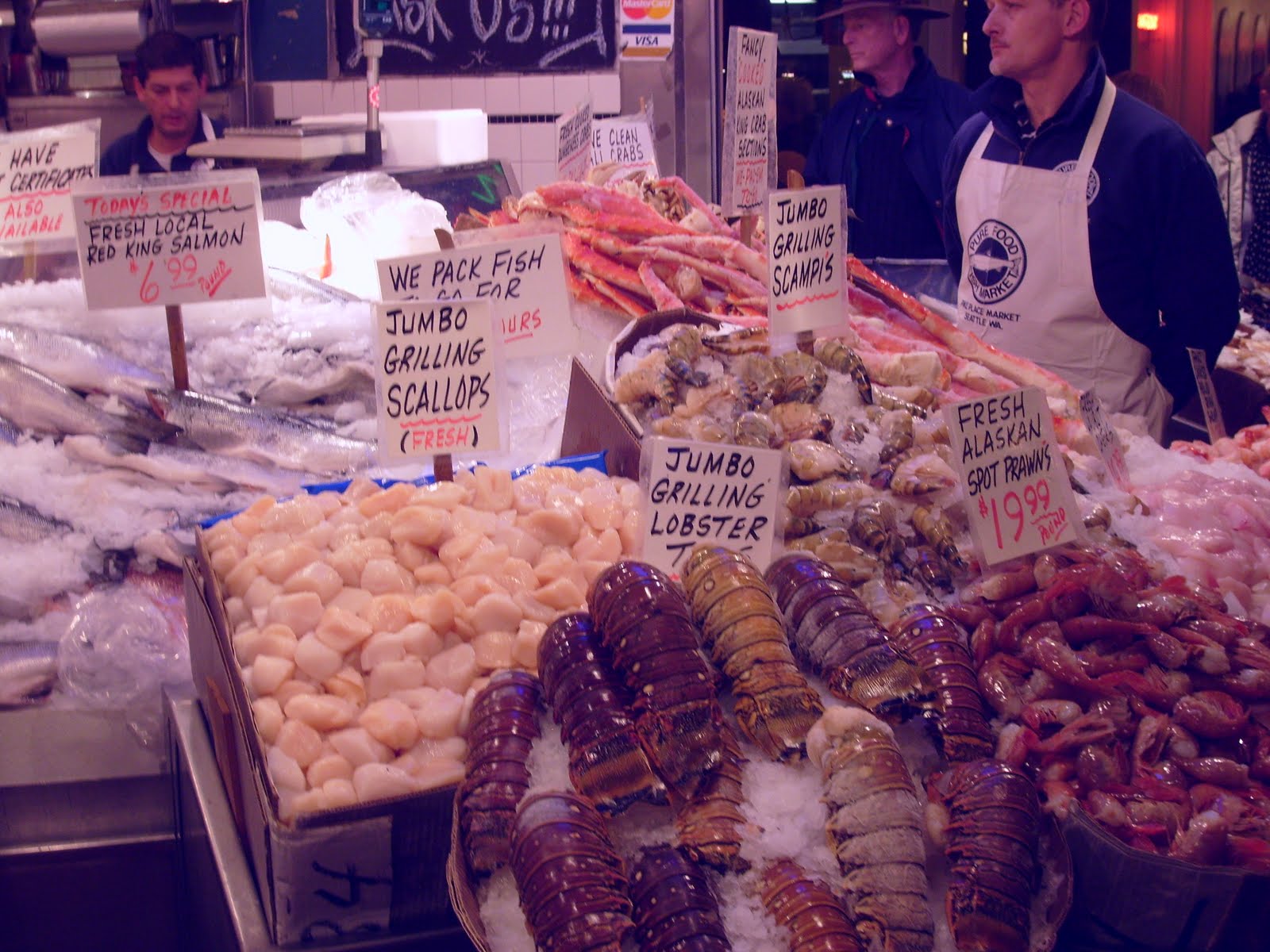
Above picture also from the Pike Place Market yesterday.

Saturday, October 30, 2010

Settling In


Weather has been pretty miserable even by Seattle standards but I was able to catch a brief sunbreak to take the top shot from the Montlake Bridge looking West. My new place would be just out of frame to the left (South) while the Univ of Washington campus and specifically the UW Medical Center is to the right (North). The Montlake Cut was just that, an artificial cut to join the once land-locked Lake Washington to Portage Bay and ultimately Puget Sound. It offers a near perfect location for crew racing being mostly sheltered from crosswinds.

This shot was from the Pike Street Public Market though not the actual famous fish shop where they throw fish. You don't get a good idea of scale here but the big Kings (aka Chinooks) in the lower right are easily three feet long. BTW while the first photo was from a digital camera the fish picture is from an iPhone and doesn't really do the scene justice.
Update: the Pike Street Public Market iconic Pig

Monday, October 25, 2010

The BruceWeb Has Landed

Well this has been an interesting two weeks. On October 14th I moved out of my place in Everett and on the Friday the 15th arrived in the University District of Seattle for house/room hunting. After a disappointing weekend I stumbled on a pretty nice situation. For those of you who know Everett Seattle I found a room in a shared house at the northernmost tip of the Montlake District, across the Montlake Cut from the University of Washington campus. The house, though a little shabby compared to its House Beautiful type neighbors, is warm and dry (the latter being REAL important in Seattle) and is perfectly situated on major bus runs going just about anywhere in Seattle and in fact the region you would want to go to work/play. The weather is miserable this week and my unlimited transit pass doesn't kick in until Nov 1st so I won't put up photos and such here just yet. But in my spare time I fully plan to play camera snapping tourist this winter and spring.

I am still moving some stuff in from storage and stocking the pantry and haven't ventured to explore the campus and community resources but I think this is going to be just fine. And when I hit my stride I will try to put up more topical blogging on Social Security etc.

A new phase begins.

Tuesday, October 05, 2010

More stuff shifted

Oddly still haven't walked around my new neighborhood, instead just shuttling between storage facilities here and there. But in a week I'm back in a college town.

And yes this blogging from iPhone thing DOES work in a pinch.